
Stop Managing Solar Revenue In Spreadsheets: A Guide To Automation
Stop Managing Solar Revenue In Spreadsheets: A Guide To Automation
Author:
John-Henry Charles
The UK solar landscape has shifted over the last few years. As subsidy-backed assets age and merchant exposure increases, the complexity of revenue management has grown.
In this guide, we break down the UK solar revenue stack, from legacy FiT schemes to modern PPA structures, and explore how AI-powered asset management tools like Alentis can turn a monthly administrative headache into a streamlined, error-proof workflow.
We recently supported an asset manager who had been running 30 sites across four different PPA structures, two legacy FiT agreement-types, and multiple REGO agreements.
Managing generation and finance across a portfolio like this meant every month was a reconciliation exercise that took the best part of two days. They were maintaining six different spreadsheets to track it all. This is not unusual. It can be the normal operating reality for a UK solar asset manager.
But with AI and the right automations, there are many ways asset managers can work smarter, not harder. Let’s get into these challenges and how Alentis helps asset managers automate painful revenue and finance headaches.

1. Power Purchase Agreements: Contracted revenue
A Power Purchase Agreement (PPA) is a contract to sell electricity. In renewable energy, it is typically an agreement between a generator and a buyer: an energy supplier, offtaker, trader, or large energy user.
PPAs are commercial contracts and can be structured in several ways:
Fixed price PPAs, where the generator receives an agreed price per MWh
Market-indexed PPAs, where the price follows a wholesale market reference
Floor-price arrangements, where the generator has some downside protection
Corporate PPAs, where a business agrees to buy renewable electricity from a specific project
On-site PPAs, where a solar asset is installed at a customer's site and the customer buys the generated electricity directly
PPAs can run for 5, 10, or 15 years. Each has its own metering arrangements, settlement terms, and billing logic. For a portfolio managing multiple PPAs with different indexation mechanisms, tracking what you are owed and when is a complex and painful administrative burden for asset management teams - and one which needs to be reviewed regularly.
Alentis tracks indexation changes across each contract automatically and catches billing discrepancies the week they occur, not the month after, when a client has already queried an invoice.

2. Feed-in Tariffs: Legacy generation and export support
The Feed-in Tariff (FiT) was a UK government scheme to encourage small-scale low-carbon electricity generation. It launched on 1 April 2010 and closed to new applicants on 1 April 2019.
FiT paid accredited generators for eligible electricity generation, with a separate export tariff for electricity sent to the grid.
FiT is no longer available to new projects. But a large portion of the UK's existing small-scale solar fleet remains on the scheme. For operators managing these legacy assets, the data still needs ingesting, rates still need verifying against RPI adjustments, and Ofgem records still need to be clean. None of it has gone away.
Alentis handles the data ingestion from legacy metering systems and verifies RPI-adjusted rates automatically, removing the need for interconnected sets of spreadsheets, which introduce risk, dependencies, and admin burden for teams.
3. Smart Export Guarantee: Export payments for small-scale generators
The Smart Export Guarantee (SEG) requires certain licensed electricity suppliers in the UK to offer export tariffs to eligible small-scale low-carbon generators.
SEG launched on 1 January 2020, after FiT closed. For solar, it is typically relevant to homes, small businesses, and smaller commercial installations that export surplus electricity to the grid.
For most commercial solar projects, the bigger value comes from on-site consumption to avoid grid imports. SEG adds a payment on top for surplus export.
But it still requires accurate half-hourly export metering, reconciled against whichever supplier tariff applies. Done manually across multiple sites, that reconciliation can be painful. Alentis audits the half-hourly data against the correct supplier tariff for each site and surfaces discrepancies before they reach month-end.
4. Contracts for Difference: Price stability for larger low-carbon projects
A Contract for Difference (CfD) is a government-backed contract between a low-carbon generator and the Low Carbon Contracts Company. It stabilises revenue by comparing a project's agreed strike price against a market reference price.
CfDs apply mainly to larger low-carbon generation projects: offshore wind, onshore wind, utility-scale solar, and other eligible technologies.
The CfD mechanism works as a two-way stabiliser:
If the market reference price falls below the strike price, the generator receives a top-up
If the market reference price rises above the strike price, the generator pays back the difference
To make it concrete: if the market reference price is £50/MWh but a solar project had a CfD strike price of £70/MW., the project receives an additional £20/MWh. If the market price rose to £90/MWh, the project would pay back £20/MWh. The generator still sells power into the market, but the CfD prevents them from keeping the full upside above the strike price.
The settlement calculations are not trivial. Clawback and top-up positions shift with real-time market prices. For a portfolio with multiple CfD assets, you need to know where you stand today, not at month-end. Alentis calculates clawback and top-up positions in real time, so cash flow forecasting is based on current data rather than last month's settlement.
5. Certificates: ROCs and REGOs
Certificates are distinct from selling electricity. They represent the renewable attributes of generation and can be sold separately or bundled into contracts.
Two certificate types matter most for UK solar:
ROCs (Renewables Obligation Certificates) came into effect in 2002. They created a requirement for electricity suppliers to source a proportion of their supply from renewable sources. Eligible generators received ROCs, which could be sold to suppliers.
The ROC scheme closed to new generating capacity on 1 April 2017. New projects cannot access ROCs. But existing accredited assets may still receive and trade them, creating an additional revenue stream on top of power sales.
REGOs (Renewable Energy Guarantees of Origin) came into effect in 2003. One REGO is issued per MWh of eligible renewable electricity generated. They are used primarily for supplier fuel mix disclosure and renewable electricity claims, and carry commercial value when sold to suppliers or buyers wanting to evidence renewable supply.
New renewable projects can still register for REGOs. For many generators, they sit alongside power sales as an additional stream. In some arrangements, REGO value is bundled into the PPA. In others, they are traded separately. The difference matters for billing accuracy, and if the allocation is not tracked carefully, the discrepancy can sit undetected for months. Alentis tracks REGO issuance against generation and flags allocation errors in bundled PPA arrangements before they compound.
The Stack Keeps Growing
New projects are increasingly complex. Less subsidy, more exposure to market prices. That means more contracts, more counterparties, more settlement mechanisms to keep on top of.
We have spoken with teams where a single billing error went unnoticed for four months. Nobody had the visibility - or the bandwidth - to cross-check the data properly. By the time it was caught, the error had been replicated across three invoices, and two client relationships were strained.
Revenue management is too critical to be handled in fragmented, error-prone spreadsheets. The asset management teams using software like Alentis are the teams that are able to scale without friction.
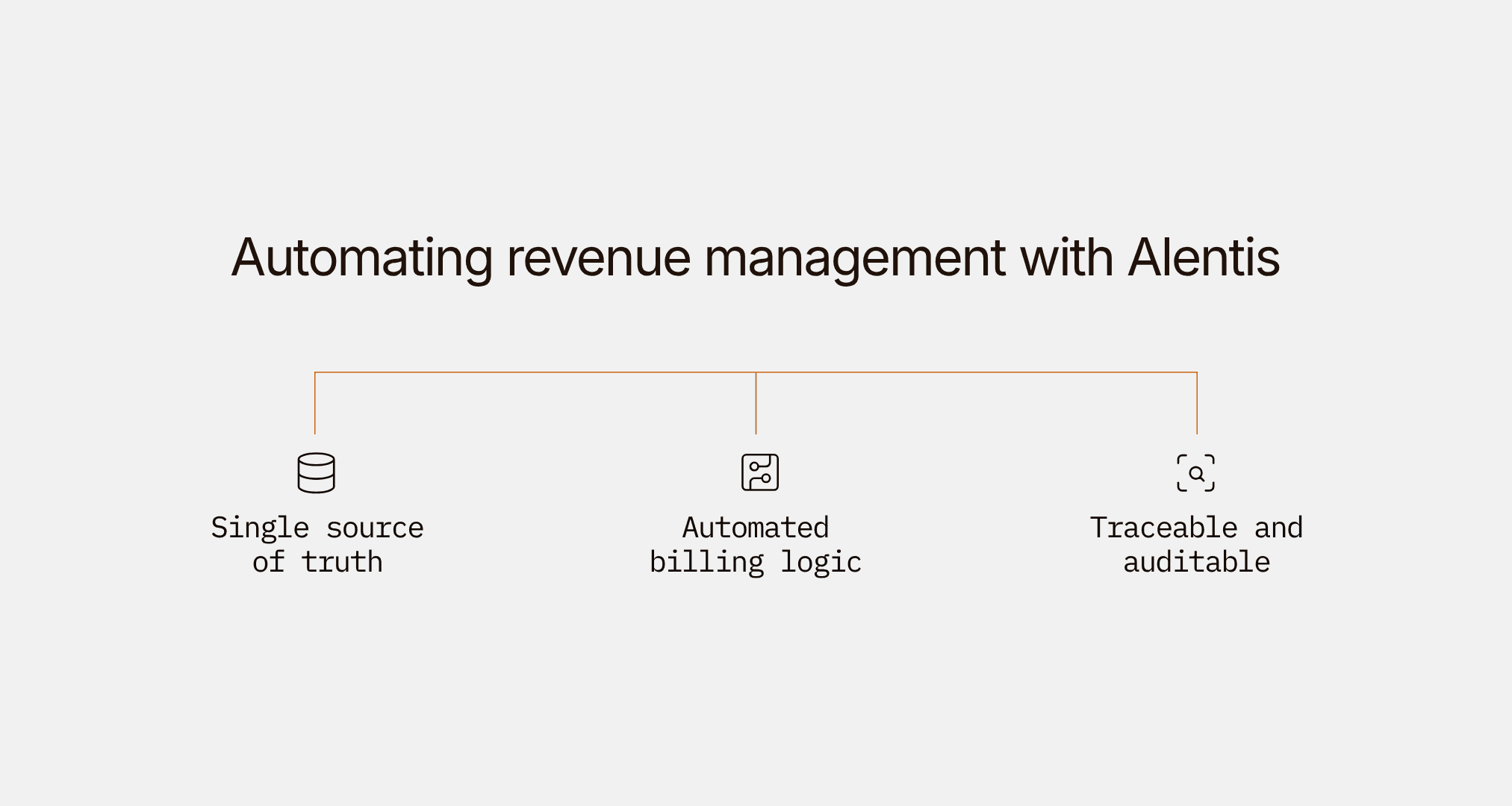
How Alentis Puts Your Solar Revenue Management on Autopilot
Step 1: Creating A Single Source of Truth For Generation Data
Before you can bill anything, you need accurate generation data. For many organisations, that means logging into a metering portal, downloading a spreadsheet, formatting it correctly, and importing it somewhere useful.
But especially if you have multiple data sources, that’s a real pain. Alentis can act as your orchestration engine, connecting directly to all your metering infrastructure, from Meteronline, to SolarEdge, SMA, Fronius, Huawei, Sungrow and others. Generation data is pulled automatically, with readings available from one-second to daily intervals depending on your setup.
No more manual downloads. By the time you open your laptop, the data is already there.
Step 2: Automating Billing Logic
Taking generation data and turning it into accurate invoices requires knowing which PPA rate applies to which site, which sites are on FiT, whether REGO value is bundled or separate, which VAT rate is correct for each customer, and which export readings feed into SEG payments.
Alentis embeds the billing logic directly into the platform. PPA rates, FiT rates, RPI adjustments, REGO allocations, and site-specific VAT rules. When the generation data comes in, the billing calculations run against it automatically.
Step 3: Creating A System That Builds Its Own Audit Trail
Getting the right number on the invoice is half the job. The other half is being able to show your working.
For Ofgem submissions, investor reporting, internal audits, and customer disputes, you need to be able to trace every figure back to its source. Which meter reading produced which generation total. Which rate was applied and why. Which REGO certificates were allocated against which contracts.
In Alentis, every calculation is traceable. The source data, the logic applied, the output, and the timestamp are all captured automatically. When a question comes in about a specific invoice, open Alentis, and the answer is there.
How To Automate Renewable Energy Operations At Scale
Alentis is built by energy operators, for energy operators. After years managing a 150-person Asset Services team across five continents, we built and designed Alentis for the workflows we lived and the problems we could not find adequate software to solve.
If your revenue stack looks anything like what we have described, a quick demo call will tell you whether Alentis is the right fit.
Talk to us today to see how Alentis can help you manage and scale your portfolio, and see how we embed with teams to become your technology partner.
The UK solar landscape has shifted over the last few years. As subsidy-backed assets age and merchant exposure increases, the complexity of revenue management has grown.
In this guide, we break down the UK solar revenue stack, from legacy FiT schemes to modern PPA structures, and explore how AI-powered asset management tools like Alentis can turn a monthly administrative headache into a streamlined, error-proof workflow.
We recently supported an asset manager who had been running 30 sites across four different PPA structures, two legacy FiT agreement-types, and multiple REGO agreements.
Managing generation and finance across a portfolio like this meant every month was a reconciliation exercise that took the best part of two days. They were maintaining six different spreadsheets to track it all. This is not unusual. It can be the normal operating reality for a UK solar asset manager.
But with AI and the right automations, there are many ways asset managers can work smarter, not harder. Let’s get into these challenges and how Alentis helps asset managers automate painful revenue and finance headaches.
1. Power Purchase Agreements: Contracted revenue
A Power Purchase Agreement (PPA) is a contract to sell electricity. In renewable energy, it is typically an agreement between a generator and a buyer: an energy supplier, offtaker, trader, or large energy user.
PPAs are commercial contracts and can be structured in several ways:
Fixed price PPAs, where the generator receives an agreed price per MWh
Market-indexed PPAs, where the price follows a wholesale market reference
Floor-price arrangements, where the generator has some downside protection
Corporate PPAs, where a business agrees to buy renewable electricity from a specific project
On-site PPAs, where a solar asset is installed at a customer's site and the customer buys the generated electricity directly
PPAs can run for 5, 10, or 15 years. Each has its own metering arrangements, settlement terms, and billing logic. For a portfolio managing multiple PPAs with different indexation mechanisms, tracking what you are owed and when is a complex and painful administrative burden for asset management teams - and one which needs to be reviewed regularly.
Alentis tracks indexation changes across each contract automatically and catches billing discrepancies the week they occur, not the month after, when a client has already queried an invoice.
2. Feed-in Tariffs: Legacy generation and export support
The Feed-in Tariff (FiT) was a UK government scheme to encourage small-scale low-carbon electricity generation. It launched on 1 April 2010 and closed to new applicants on 1 April 2019.
FiT paid accredited generators for eligible electricity generation, with a separate export tariff for electricity sent to the grid.
FiT is no longer available to new projects. But a large portion of the UK's existing small-scale solar fleet remains on the scheme. For operators managing these legacy assets, the data still needs ingesting, rates still need verifying against RPI adjustments, and Ofgem records still need to be clean. None of it has gone away.
Alentis handles the data ingestion from legacy metering systems and verifies RPI-adjusted rates automatically, removing the need for interconnected sets of spreadsheets, which introduce risk, dependencies, and admin burden for teams.
3. Smart Export Guarantee: Export payments for small-scale generators
The Smart Export Guarantee (SEG) requires certain licensed electricity suppliers in the UK to offer export tariffs to eligible small-scale low-carbon generators.
SEG launched on 1 January 2020, after FiT closed. For solar, it is typically relevant to homes, small businesses, and smaller commercial installations that export surplus electricity to the grid.
For most commercial solar projects, the bigger value comes from on-site consumption to avoid grid imports. SEG adds a payment on top for surplus export.
But it still requires accurate half-hourly export metering, reconciled against whichever supplier tariff applies. Done manually across multiple sites, that reconciliation can be painful. Alentis audits the half-hourly data against the correct supplier tariff for each site and surfaces discrepancies before they reach month-end.
4. Contracts for Difference: Price stability for larger low-carbon projects
A Contract for Difference (CfD) is a government-backed contract between a low-carbon generator and the Low Carbon Contracts Company. It stabilises revenue by comparing a project's agreed strike price against a market reference price.
CfDs apply mainly to larger low-carbon generation projects: offshore wind, onshore wind, utility-scale solar, and other eligible technologies.
The CfD mechanism works as a two-way stabiliser:
If the market reference price falls below the strike price, the generator receives a top-up
If the market reference price rises above the strike price, the generator pays back the difference
To make it concrete: if the market reference price is £50/MWh but a solar project had a CfD strike price of £70/MW., the project receives an additional £20/MWh. If the market price rose to £90/MWh, the project would pay back £20/MWh. The generator still sells power into the market, but the CfD prevents them from keeping the full upside above the strike price.
The settlement calculations are not trivial. Clawback and top-up positions shift with real-time market prices. For a portfolio with multiple CfD assets, you need to know where you stand today, not at month-end. Alentis calculates clawback and top-up positions in real time, so cash flow forecasting is based on current data rather than last month's settlement.
5. Certificates: ROCs and REGOs
Certificates are distinct from selling electricity. They represent the renewable attributes of generation and can be sold separately or bundled into contracts.
Two certificate types matter most for UK solar:
ROCs (Renewables Obligation Certificates) came into effect in 2002. They created a requirement for electricity suppliers to source a proportion of their supply from renewable sources. Eligible generators received ROCs, which could be sold to suppliers.
The ROC scheme closed to new generating capacity on 1 April 2017. New projects cannot access ROCs. But existing accredited assets may still receive and trade them, creating an additional revenue stream on top of power sales.
REGOs (Renewable Energy Guarantees of Origin) came into effect in 2003. One REGO is issued per MWh of eligible renewable electricity generated. They are used primarily for supplier fuel mix disclosure and renewable electricity claims, and carry commercial value when sold to suppliers or buyers wanting to evidence renewable supply.
New renewable projects can still register for REGOs. For many generators, they sit alongside power sales as an additional stream. In some arrangements, REGO value is bundled into the PPA. In others, they are traded separately. The difference matters for billing accuracy, and if the allocation is not tracked carefully, the discrepancy can sit undetected for months. Alentis tracks REGO issuance against generation and flags allocation errors in bundled PPA arrangements before they compound.
The Stack Keeps Growing
New projects are increasingly complex. Less subsidy, more exposure to market prices. That means more contracts, more counterparties, more settlement mechanisms to keep on top of.
We have spoken with teams where a single billing error went unnoticed for four months. Nobody had the visibility - or the bandwidth - to cross-check the data properly. By the time it was caught, the error had been replicated across three invoices, and two client relationships were strained.
Revenue management is too critical to be handled in fragmented, error-prone spreadsheets. The asset management teams using software like Alentis are the teams that are able to scale without friction.
How Alentis Puts Your Solar Revenue Management on Autopilot
Step 1: Creating A Single Source of Truth For Generation Data
Before you can bill anything, you need accurate generation data. For many organisations, that means logging into a metering portal, downloading a spreadsheet, formatting it correctly, and importing it somewhere useful.
But especially if you have multiple data sources, that’s a real pain. Alentis can act as your orchestration engine, connecting directly to all your metering infrastructure, from Meteronline, to SolarEdge, SMA, Fronius, Huawei, Sungrow and others. Generation data is pulled automatically, with readings available from one-second to daily intervals depending on your setup.
No more manual downloads. By the time you open your laptop, the data is already there.
Step 2: Automating Billing Logic
Taking generation data and turning it into accurate invoices requires knowing which PPA rate applies to which site, which sites are on FiT, whether REGO value is bundled or separate, which VAT rate is correct for each customer, and which export readings feed into SEG payments.
Alentis embeds the billing logic directly into the platform. PPA rates, FiT rates, RPI adjustments, REGO allocations, and site-specific VAT rules. When the generation data comes in, the billing calculations run against it automatically.
Step 3: Creating A System That Builds Its Own Audit Trail
Getting the right number on the invoice is half the job. The other half is being able to show your working.
For Ofgem submissions, investor reporting, internal audits, and customer disputes, you need to be able to trace every figure back to its source. Which meter reading produced which generation total. Which rate was applied and why. Which REGO certificates were allocated against which contracts.
In Alentis, every calculation is traceable. The source data, the logic applied, the output, and the timestamp are all captured automatically. When a question comes in about a specific invoice, open Alentis, and the answer is there.
How To Automate Renewable Energy Operations At Scale
Alentis is built by energy operators, for energy operators. After years managing a 150-person Asset Services team across five continents, we built and designed Alentis for the workflows we lived and the problems we could not find adequate software to solve.
If your revenue stack looks anything like what we have described, a quick demo call will tell you whether Alentis is the right fit.
Talk to us today to see how Alentis can help you manage and scale your portfolio, and see how we embed with teams to become your technology partner.


