
Case Study: Detecting duplicate and recurrent O&M evidence
Case Study: Detecting duplicate and recurrent O&M evidence
Author:
John-Henry Charles
Managing O&M reports in Europe for utility solar farms can be complex. As the average price of electricity in Europe tends to be ~€200/MWh, asset managers have a responsibility to have a deep understanding of all the good work that is being done by O&M providers.
We worked with one of our utility-scale clients to automatically extract, structure and cross-check maintenance evidence at scale, surfacing duplicate and recurring issues that would otherwise stay buried in reports from your O&M provider or internal maintenance team.
At a glance
100,000+ pages of maintenance reports processed every month per GW, across 10+ O&M providers
Reports arrived in mixed formats: PDFs, spreadsheets and emails
Duplicate images and recurring faults flagged automatically across reports
Team time spent tracking O&M work cut by more than 75%
The challenge
The client works with more than 10 O&M providers across a large utility-scale portfolio. Each provider submits maintenance reports in a different way: some by email, some through portals, some as scanned PDFs with embedded images.
Multiply that across hundreds of sites and thousands of individual jobs, and the volume of evidence quickly outpaces what any team can review by hand.
At that scale, cross-referencing became one of the most painful administrative problems. The same photo of a faulty inverter might get submitted for two separate jobs, and a fault marked as resolved in one report can resurface in another a few weeks later.
Without tools to automate painful admin tasks like this, or structured ways to compare reports side by side, these issues are hard to spot and information can fall through the cracks.
Evidence gets lost or missed because there is simply too much coming in for even the biggest teams to manage.
The solution
We worked with the client to build a new feature of our Work Management module that automatically extracts and structures the content of every maintenance report as it comes in.
The tool can handle multiple formats and sources, with images, fault descriptions, parts used and completion dates all pulled out and stored against the relevant site and work order, rather than left sitting in a PDF.
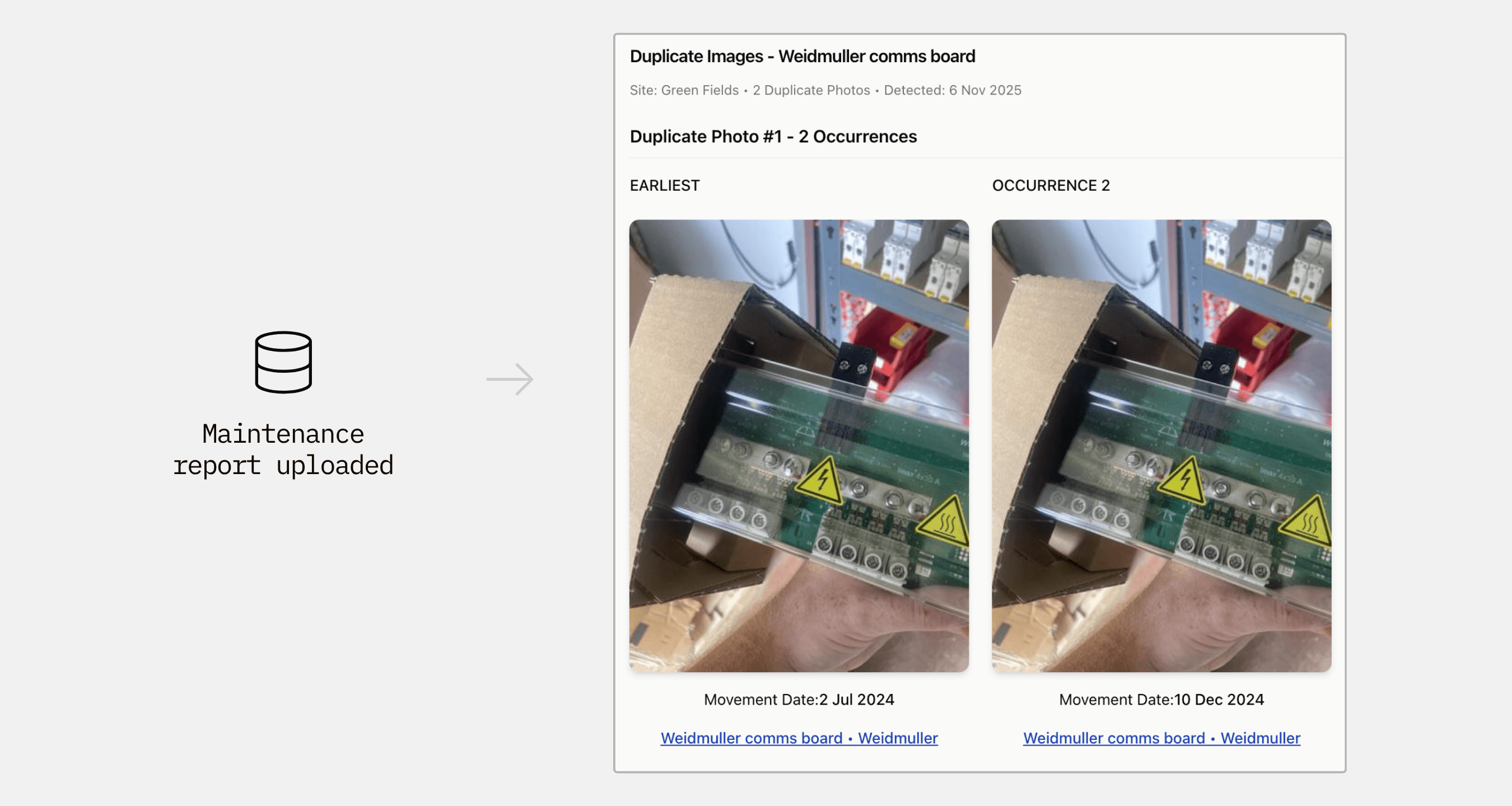
As reports are processed, Alentis checks new evidence against everything already logged for that portfolio, flagging duplicate images and recurring evidence across providers and reports.
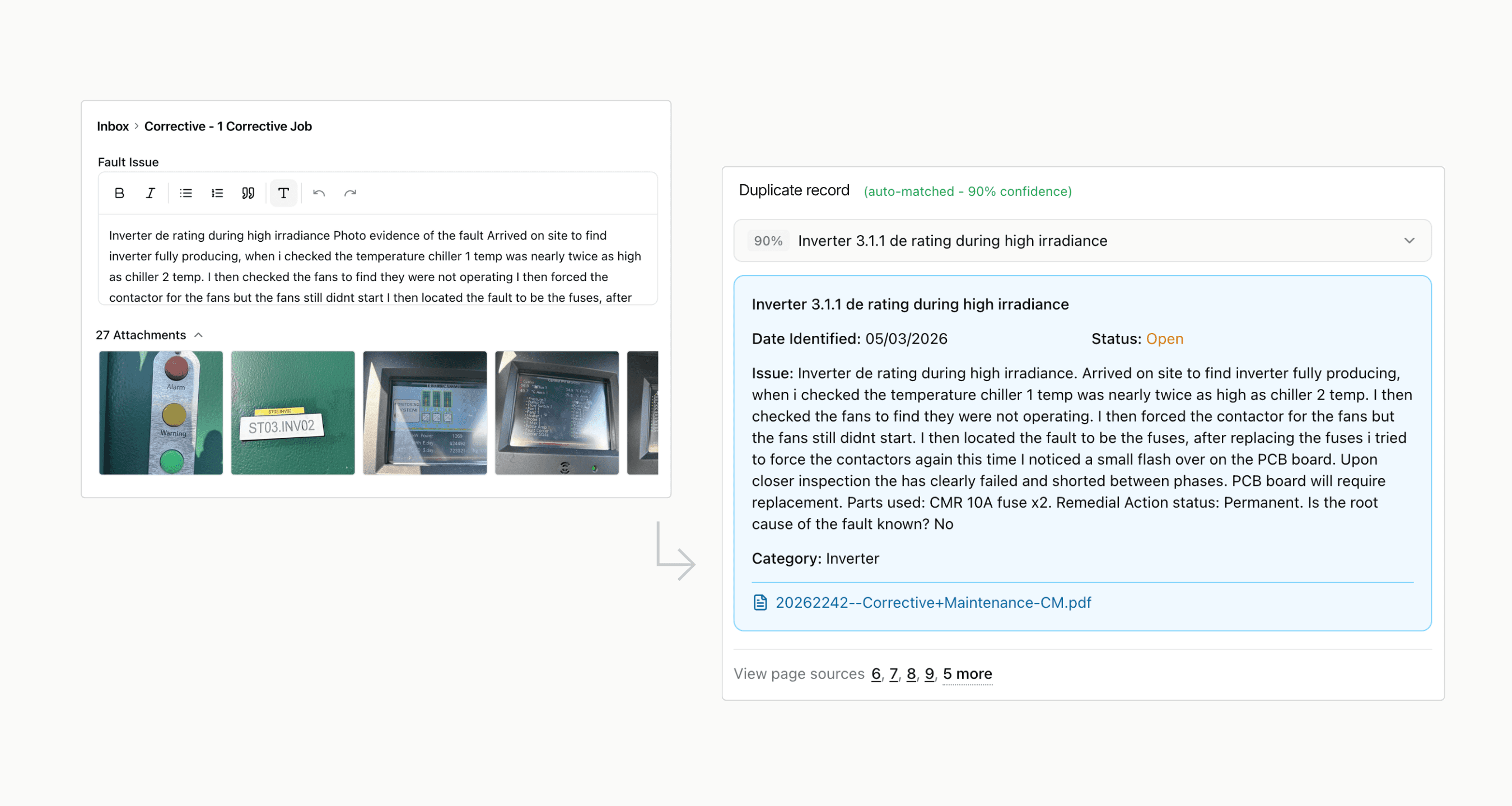
Instead of asset managers manually comparing reports to catch repeat issues, the pattern is surfaced automatically, with the original evidence linked for reference.
The impact
Alentis now processes more than 300,000 pages of maintenance reports for this client every month, across 10+ O&M providers. All of it is structured, searchable, and checked for duplicates and recurring issues as standard.
The client's team now spends 75% less time tracking O&M work, since they are no longer manually piecing together what has been done, by whom, and whether it is actually new.
There is significantly reduced risks of missing critical outages, health & safety issues and reducing lead times for managing critical spares inventory, as Alentis flags all of this information directly to you.
Book a quick 30-minute demo for Alentis today to get access to our work management & inventory modules and much more.
Managing O&M reports in Europe for utility solar farms can be complex. As the average price of electricity in Europe tends to be ~€200/MWh, asset managers have a responsibility to have a deep understanding of all the good work that is being done by O&M providers.
We worked with one of our utility-scale clients to automatically extract, structure and cross-check maintenance evidence at scale, surfacing duplicate and recurring issues that would otherwise stay buried in reports from your O&M provider or internal maintenance team.
At a glance
100,000+ pages of maintenance reports processed every month per GW, across 10+ O&M providers
Reports arrived in mixed formats: PDFs, spreadsheets and emails
Duplicate images and recurring faults flagged automatically across reports
Team time spent tracking O&M work cut by more than 75%
The challenge
The client works with more than 10 O&M providers across a large utility-scale portfolio. Each provider submits maintenance reports in a different way: some by email, some through portals, some as scanned PDFs with embedded images.
Multiply that across hundreds of sites and thousands of individual jobs, and the volume of evidence quickly outpaces what any team can review by hand.
At that scale, cross-referencing became one of the most painful administrative problems. The same photo of a faulty inverter might get submitted for two separate jobs, and a fault marked as resolved in one report can resurface in another a few weeks later.
Without tools to automate painful admin tasks like this, or structured ways to compare reports side by side, these issues are hard to spot and information can fall through the cracks.
Evidence gets lost or missed because there is simply too much coming in for even the biggest teams to manage.
The solution
We worked with the client to build a new feature of our Work Management module that automatically extracts and structures the content of every maintenance report as it comes in.
The tool can handle multiple formats and sources, with images, fault descriptions, parts used and completion dates all pulled out and stored against the relevant site and work order, rather than left sitting in a PDF.
As reports are processed, Alentis checks new evidence against everything already logged for that portfolio, flagging duplicate images and recurring evidence across providers and reports.
Instead of asset managers manually comparing reports to catch repeat issues, the pattern is surfaced automatically, with the original evidence linked for reference.
The impact
Alentis now processes more than 300,000 pages of maintenance reports for this client every month, across 10+ O&M providers. All of it is structured, searchable, and checked for duplicates and recurring issues as standard.
The client's team now spends 75% less time tracking O&M work, since they are no longer manually piecing together what has been done, by whom, and whether it is actually new.
There is significantly reduced risks of missing critical outages, health & safety issues and reducing lead times for managing critical spares inventory, as Alentis flags all of this information directly to you.
Book a quick 30-minute demo for Alentis today to get access to our work management & inventory modules and much more.


