
Author:
John-Henry Charles
Every day, thousands of asset managers are dealing with an existential problem: portfolios are growing exponentially, but the burden of piling up paperwork is slowing everything down.
Before asset managers can generate a single insight, optimise performance, or reduce downtime, they first have to fight through thousands of pages of documentation during onboarding.
Contracts. Commissioning reports. Compliance certificates. Grid approvals. Safety documentation.
One customer told us they routinely received a single onboarding file from an O&M provider that was over 1000 pages long. That’s just one document – for one site.
Now multiply that across a growing portfolio.
For a fast-growing renewable energy asset manager, onboarding a new site is becoming too much work to manage. A single new site takes days to bring to steady-state asset management.
Getting into this detail is important. But in many cases, it’s too manual and too much. What teams are left with is endless, messy cross-referencing and PDF-doomscrolling, and individuals confused by duplicate, inconsistent entries.
Gaps, traceability and excel chaos
Without having a proper system in place, teams are stuck manually cross-referencing PDFs, jumping between spreadsheets, and trying to reconcile duplicate or inconsistent data during the onboarding process.
Was every checklist item truly verified? Was support evidence complete or just assumed? Who verified the information? Could decisions be traced back to source documents during an audit? Were inconsistencies silently slipping through? Did the file names or folder structures actually make sense?
This uncertainty translated directly as both cost and risk.
And most importantly, the team was paying a paperwork tax. The cost of onboarding rooftop solar sites was becoming so high that it started to impact the viability of their commercial offering.
From manual review to Alentis Intelligence
We’ve personally experienced these problems, and we see them daily with the renewable energy operators we work with, so we introduced our AI-powered onboarding agent to eliminate the paperwork tax at its root.
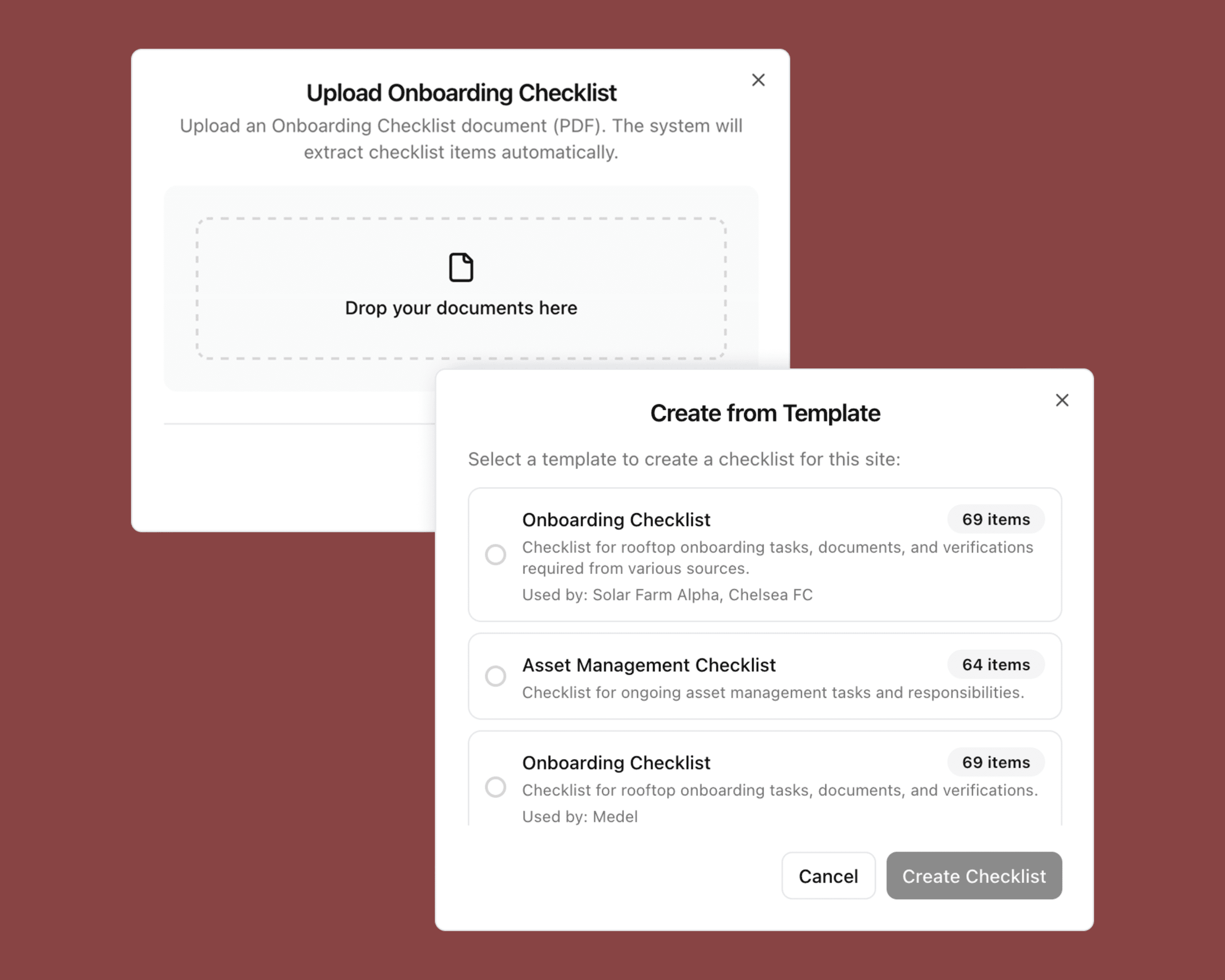
Step 1: Define what “complete” looks like
Teams start by uploading their onboarding checklists or using Alentis standard templates.
These define exactly what needs to be verified across compliance, safety, contracts, and operations.
These checklist items can be wide-ranging, and can be applied across multiple sites instantly, ensuring consistency from day one.
Step 2: Upload documents, and let Alentis do the heavy lifting
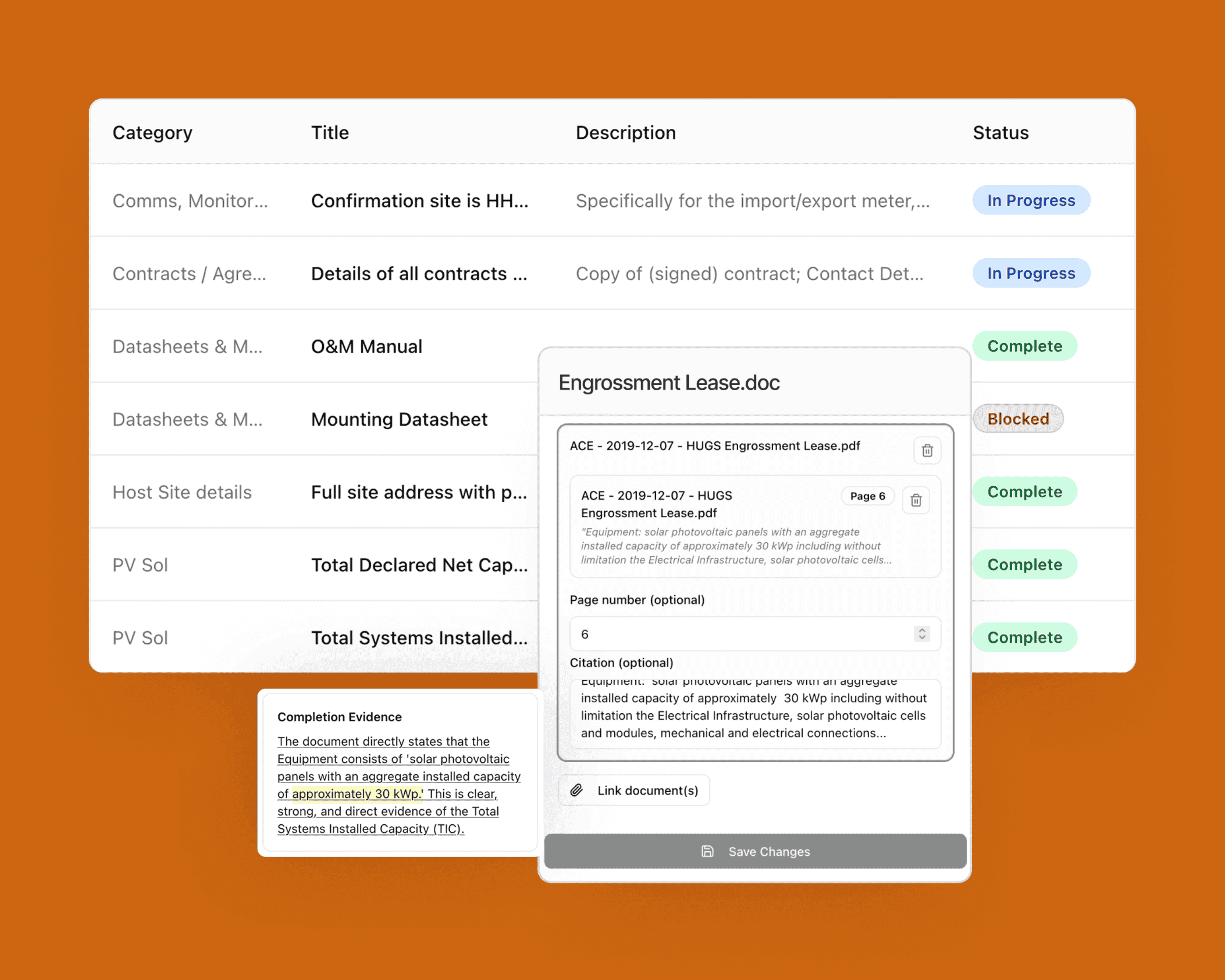
Instead of manually reviewing files, teams simply upload their documents. Alentis’ onboarding agent then:
Analyzes every document automatically against the checklist
Identifies relevant information across hundreds of pages
Extracts supporting evidence, fully cited to the exact page and text
Surfaces results in a structured format, ready for review
Every piece of information is traceable back to its source.
Step 3: The right people in the loop for the final review.
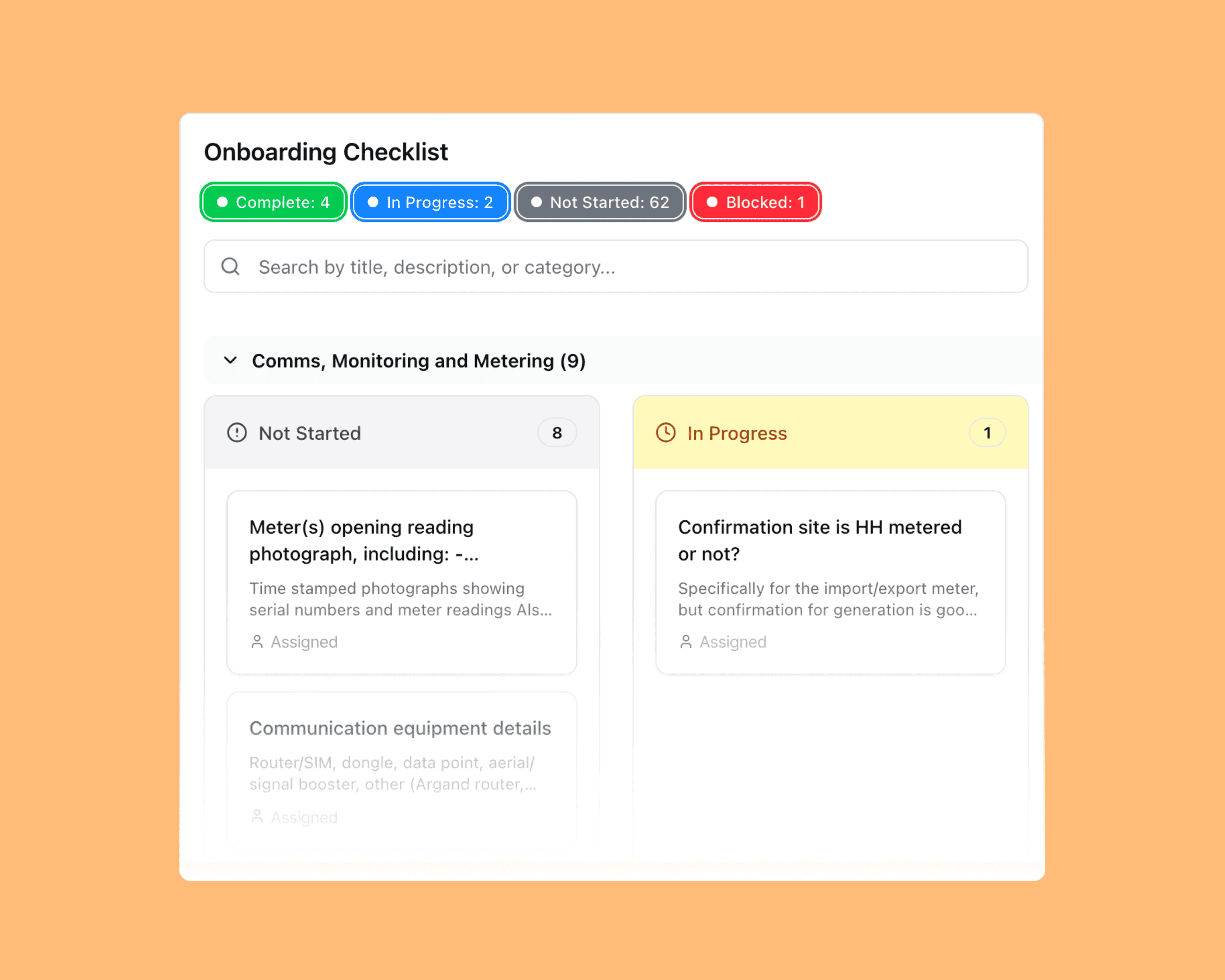
Alentis suggests task completion based on extracted evidence, and keeps the right stakeholders in control to review evidence, adjust or reject suggestions and confirm completion.
Structured insight, with audit trails in-built by default
With Alentis, sites can be onboarded in minutes. Evidence is automatically surfaced and structured, inconsistencies are flagged immediately and audit trails are built in by default.
Scaling operations should not mean scaling admin. With Alentis, teams are experiencing fewer onboarding bottlenecks, a lower paperwork tax, and better control of risk and cost.
By eliminating the paperwork tax at its root, we’re making it possible to onboard faster, operate smarter, and scale without friction.
That’s the future of energy operations.
And we’re building it at Alentis.
This is one of many workflows that we have built. If you are interested in how Alentis can improve your 'hair on fire' problems, get in touch johnhenry@alentisenergy.com


