Solar Asset Management Software For 10-100 Sites: A Buyer's Guide
Solar Asset Management Software For 10-100 Sites: A Buyer's Guide
Author:
Hugo Douglas-Deane
Many businesses today are effectively run using the humble spreadsheet. There’s praise due to the power of Excel, but there are also major downsides and risks when it comes to asset management and energy operations.
Ask asset managers, logistics and operations teams when their systems stopped working and you'll get a moment rather than a date – our industries are full of stories about the day an intern accidentally deleted a formula in a cell, causing a chain of macros to stop working.
Stories like these are signs of a team that have outgrown their tools, with most C&I teams hitting this tipping point somewhere between 10-20 sites.
So when spreadsheets and internal tools are breaking what should you do?
In this blog we’ll explore the pros and cons of potential solutions and give you some tips on how to evaluate your options for solar asset management software.
Where Spreadsheets Stop Working
Spreadsheets are powerful things, but they can be a huge risk for solar asset management.
There are a number of key risks:
A spreadsheet model carrying generation data, invoicing and contract dates for more than ten sites will have thousands of dependencies. One pasted column is all it takes for the numbers to go wrong in a way that nobody catches until the damage has already been done.
The individuals who build these spreadsheet systems often have the logic in their head, so when they leave, the knowledge leaves with them. Most C&I teams we meet have at least one file that nobody currently employed will touch without wincing.
Spreadsheets are not able to integrate with your data sources. The data from meter portals, inverter APIs and O&M reports needs to be added by hand, so the picture you have of your portfolio is dependent on huge amounts of admin and data handling.
Nobody outside your organisation can work with you on them synchronously. Sending spreadsheets back and forth over email is inefficient and painful. So O&M providers and field engineers tend to work in their own systems, while asset managers work in theirs, while somebody in the middle does the data entry. The moment your single source of truth depends on manual re-entry, it stops being one.
Alternatives to Spreadsheets for Solar Asset Management
Enterprise asset management systems and ERPs
Large systems like IFS and SAP are very capable, but they’re built for manufacturing and utilities rather than renewables operations. The problem for a portfolio your size is the shape of the cost and commitment required to set them up – implementation runs in quarters, configuring it to your needs requires a consultant, and ERP licences are often very long-term burdensome commitments.
Most have added AI in the last two years, usually a chat window sitting over data somebody already keyed in. This can help when your question is about a field in the database, but it does nothing when the answer lives in clause 14.3 of a lease that was scanned in 2014. This is not a truly AI-native approach, and doesn’t leverage the huge power of AI to automate the truly painful data entry jobs which you shouldn’t have to do.
Dedicated renewables platforms
Most of the specialists in this market like Powerfactors and Meteocontrol grew out of generation monitoring, and it shows. They are good at performance data, alerting and yield analysis. That's the problem they set out to solve, but they rarely cover other workflows that are a huge part of your day to day.
Contract obligations, work and repairs management, spares and invoicing rarely feature in these solutions, and if they do they are often after-thoughts. Several of the options we’ve tested were designed around utility-scale assumptions that don't survive contact with a rooftop portfolio: one landlord per site, one meter, one offtaker, one contract.
There's a fair version of this too. If generation performance is genuinely your main problem, buy a monitoring platform and don't overthink it. The argument for something broader only holds if the work around the generation data is what's eating your week.
But be wary – ask any vendor when someone on their team last sat with an O&M crew or ran a billing cycle end to end. The answer tells you whether the product was truly designed around the whole picture of your operations.
Building it yourself
The tech landscape has changed a lot over the last couple of years, and there are lots of ways people can build things themselves.
AI coding tools mean a capable asset manager can now build something workable in a weekend, and we’re seeing more clients arrive with something they've built themselves, and it's genuinely impressive to see. We write software for a living, so we're not about to tell anyone that building is a bad instinct.
What we would say is that the initial build may be quick to do, but clients often find these tools quickly fall apart.
Tools that work for 5 sites and two internal users tend to buckle at 30 sites, especially when you bring other external users into the picture, like an O&M provider.
There are also hidden security risks, from authentication and permissions to audit trails and backups, these are critical considerations that are part of how we build effective and stable software for live assets and operations.
Prototype code has a way of becoming production code without some of the checks and balances that are needed, and you can often be left maintaining a system with logic that isn’t entirely clear.
If you choose to build your own tools, price in the five-year maintenance and security bill – and make sure you’re comfortable with the potential security and data risk.
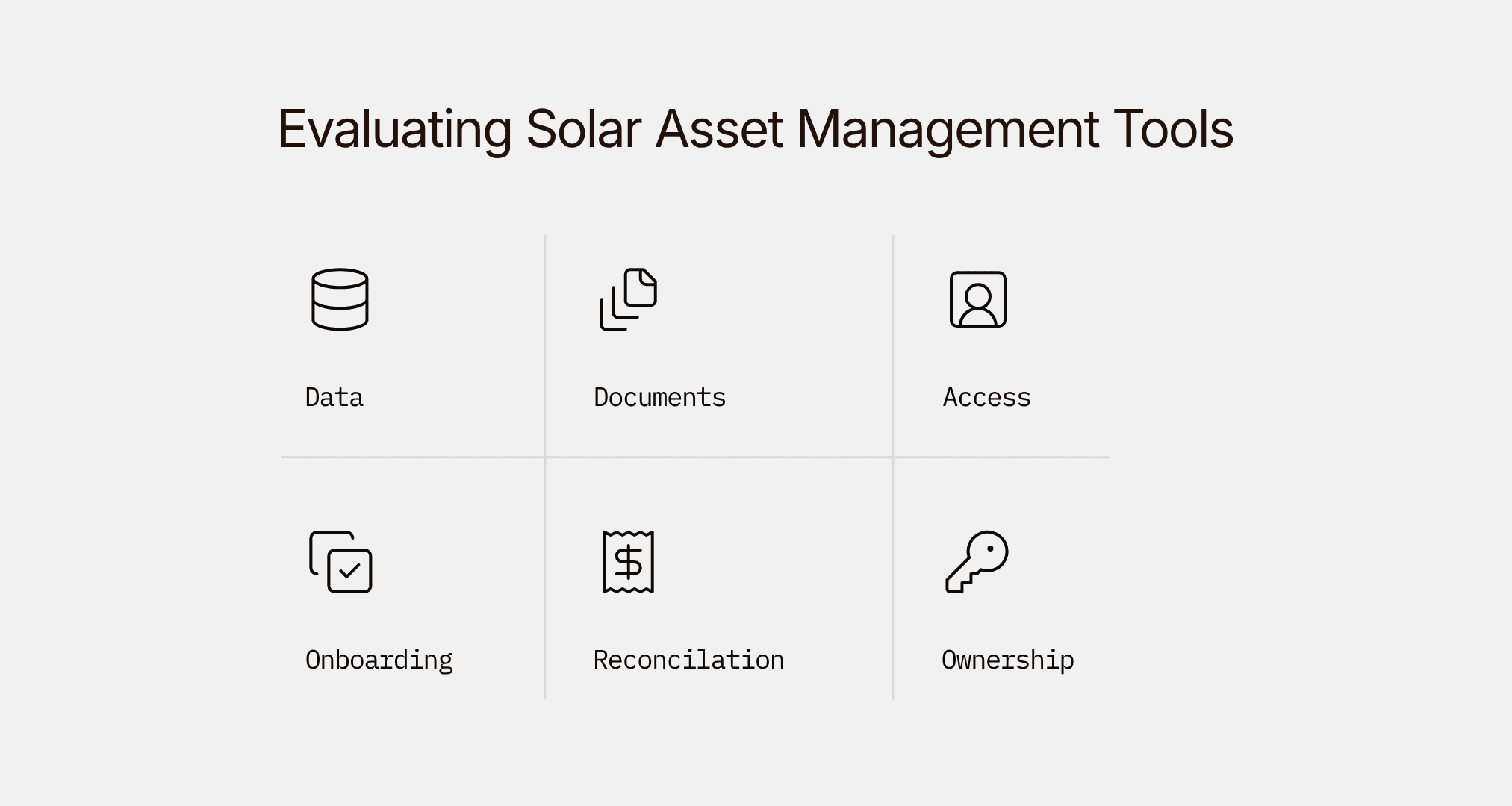
What To Consider When You Evaluate Solar Asset Management Tools
Six questions that can help you to quickly evaluate the options.
How long until my data is in and usable, and who does that work?
Months of configuration done by your own team is a cost, and it won’t be on the invoice they give you.
Can it read my documents, or only my meters?
Ask them to search a scanned contract in a language they haven't seen before, live on the call.
Can my O&M providers and field engineers use it?
If work can't be recorded where it happens, you're back to re-entry, and it means less accountability.
Can I build a workflow for something specific to my portfolio without waiting for a roadmap?
Every C&I portfolio has something odd in it.
Does invoicing actually reconcile?
Generation to PPA terms to invoice to accounting software, with REGO and ROC calculations handled, rather than a CSV export and a ‘good luck’.
Who answers when it breaks?
Ask whether you'll reach the people who built the product or an outsourced support desk.
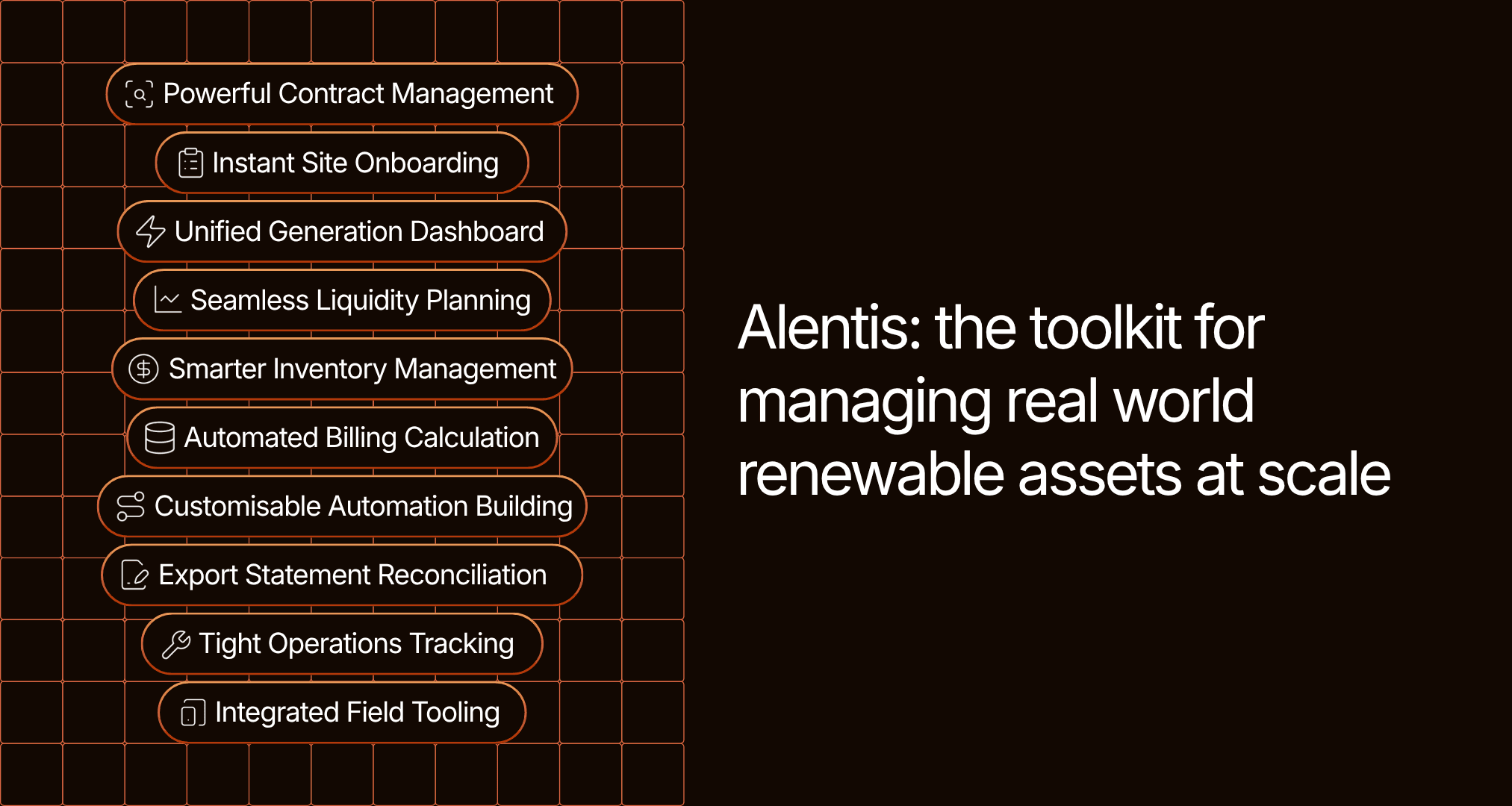
Alentis Is A Powerful, Stable and Flexible Alternative To Spreadsheets
We’ve built Alentis specifically for portfolios of this size, starting with the vital information you already own but often can’t use.
Most of what governs your financial outcomes, from PPA terms and escalators to lease obligations and warranty windows, is trapped in documents rather than stored in databases.
Alentis structures this data for you, indexing your documentation so your team doesn’t have to key it all in. By bringing generation and billing into the same system as your contracts, work tracking, and spares, the workflows that take you days every month can be done in a few minutes.
Repowering London use Alentis to create a single source of truth, tracking works, contractors and outstanding items, with the supporting documentation attached to everything.
“Alentis has given us the structure and visibility we needed to manage a complex portfolio more proactively, improving continuity, reliability, and confidence across our operations as we scale.”
– Lorraine Haskell, Head of Asset Management, Repowering London
On the C&I generation-to-billing side we've taken that workflow to full automation, with an auditable trail for every invoice and payment. We help our clients achieve on average a 5x output from the same headcount.
Energise South Downs automated their entire billing cycle using Alentis – just one of the ways we give back days of time to teams.
Our pricing sits well below enterprise tooling. We build what clients ask for rather than what looks good in an investment deck, and when something breaks you talk to an engineer.
If your portfolio is growing and the spreadsheets are starting to creak, book a 30-minute demo to see how Alentis can make your energy operations effortless.
Many businesses today are effectively run using the humble spreadsheet. There’s praise due to the power of Excel, but there are also major downsides and risks when it comes to asset management and energy operations.
Ask asset managers, logistics and operations teams when their systems stopped working and you'll get a moment rather than a date – our industries are full of stories about the day an intern accidentally deleted a formula in a cell, causing a chain of macros to stop working.
Stories like these are signs of a team that have outgrown their tools, with most C&I teams hitting this tipping point somewhere between 10-20 sites.
So when spreadsheets and internal tools are breaking what should you do?
In this blog we’ll explore the pros and cons of potential solutions and give you some tips on how to evaluate your options for solar asset management software.
Where Spreadsheets Stop Working
Spreadsheets are powerful things, but they can be a huge risk for solar asset management.
There are a number of key risks:
A spreadsheet model carrying generation data, invoicing and contract dates for more than ten sites will have thousands of dependencies. One pasted column is all it takes for the numbers to go wrong in a way that nobody catches until the damage has already been done.
The individuals who build these spreadsheet systems often have the logic in their head, so when they leave, the knowledge leaves with them. Most C&I teams we meet have at least one file that nobody currently employed will touch without wincing.
Spreadsheets are not able to integrate with your data sources. The data from meter portals, inverter APIs and O&M reports needs to be added by hand, so the picture you have of your portfolio is dependent on huge amounts of admin and data handling.
Nobody outside your organisation can work with you on them synchronously. Sending spreadsheets back and forth over email is inefficient and painful. So O&M providers and field engineers tend to work in their own systems, while asset managers work in theirs, while somebody in the middle does the data entry. The moment your single source of truth depends on manual re-entry, it stops being one.
Alternatives to Spreadsheets for Solar Asset Management
Enterprise asset management systems and ERPs
Large systems like IFS and SAP are very capable, but they’re built for manufacturing and utilities rather than renewables operations. The problem for a portfolio your size is the shape of the cost and commitment required to set them up – implementation runs in quarters, configuring it to your needs requires a consultant, and ERP licences are often very long-term burdensome commitments.
Most have added AI in the last two years, usually a chat window sitting over data somebody already keyed in. This can help when your question is about a field in the database, but it does nothing when the answer lives in clause 14.3 of a lease that was scanned in 2014. This is not a truly AI-native approach, and doesn’t leverage the huge power of AI to automate the truly painful data entry jobs which you shouldn’t have to do.
Dedicated renewables platforms
Most of the specialists in this market like Powerfactors and Meteocontrol grew out of generation monitoring, and it shows. They are good at performance data, alerting and yield analysis. That's the problem they set out to solve, but they rarely cover other workflows that are a huge part of your day to day.
Contract obligations, work and repairs management, spares and invoicing rarely feature in these solutions, and if they do they are often after-thoughts. Several of the options we’ve tested were designed around utility-scale assumptions that don't survive contact with a rooftop portfolio: one landlord per site, one meter, one offtaker, one contract.
There's a fair version of this too. If generation performance is genuinely your main problem, buy a monitoring platform and don't overthink it. The argument for something broader only holds if the work around the generation data is what's eating your week.
But be wary – ask any vendor when someone on their team last sat with an O&M crew or ran a billing cycle end to end. The answer tells you whether the product was truly designed around the whole picture of your operations.
Building it yourself
The tech landscape has changed a lot over the last couple of years, and there are lots of ways people can build things themselves.
AI coding tools mean a capable asset manager can now build something workable in a weekend, and we’re seeing more clients arrive with something they've built themselves, and it's genuinely impressive to see. We write software for a living, so we're not about to tell anyone that building is a bad instinct.
What we would say is that the initial build may be quick to do, but clients often find these tools quickly fall apart.
Tools that work for 5 sites and two internal users tend to buckle at 30 sites, especially when you bring other external users into the picture, like an O&M provider.
There are also hidden security risks, from authentication and permissions to audit trails and backups, these are critical considerations that are part of how we build effective and stable software for live assets and operations.
Prototype code has a way of becoming production code without some of the checks and balances that are needed, and you can often be left maintaining a system with logic that isn’t entirely clear.
If you choose to build your own tools, price in the five-year maintenance and security bill – and make sure you’re comfortable with the potential security and data risk.
What To Consider When You Evaluate Solar Asset Management Tools
Six questions that can help you to quickly evaluate the options.
How long until my data is in and usable, and who does that work?
Months of configuration done by your own team is a cost, and it won’t be on the invoice they give you.
Can it read my documents, or only my meters?
Ask them to search a scanned contract in a language they haven't seen before, live on the call.
Can my O&M providers and field engineers use it?
If work can't be recorded where it happens, you're back to re-entry, and it means less accountability.
Can I build a workflow for something specific to my portfolio without waiting for a roadmap?
Every C&I portfolio has something odd in it.
Does invoicing actually reconcile?
Generation to PPA terms to invoice to accounting software, with REGO and ROC calculations handled, rather than a CSV export and a ‘good luck’.
Who answers when it breaks?
Ask whether you'll reach the people who built the product or an outsourced support desk.
Alentis Is A Powerful, Stable and Flexible Alternative To Spreadsheets
We’ve built Alentis specifically for portfolios of this size, starting with the vital information you already own but often can’t use.
Most of what governs your financial outcomes, from PPA terms and escalators to lease obligations and warranty windows, is trapped in documents rather than stored in databases.
Alentis structures this data for you, indexing your documentation so your team doesn’t have to key it all in. By bringing generation and billing into the same system as your contracts, work tracking, and spares, the workflows that take you days every month can be done in a few minutes.
Repowering London use Alentis to create a single source of truth, tracking works, contractors and outstanding items, with the supporting documentation attached to everything.
“Alentis has given us the structure and visibility we needed to manage a complex portfolio more proactively, improving continuity, reliability, and confidence across our operations as we scale.”
– Lorraine Haskell, Head of Asset Management, Repowering London
On the C&I generation-to-billing side we've taken that workflow to full automation, with an auditable trail for every invoice and payment. We help our clients achieve on average a 5x output from the same headcount.
Energise South Downs automated their entire billing cycle using Alentis – just one of the ways we give back days of time to teams.
Our pricing sits well below enterprise tooling. We build what clients ask for rather than what looks good in an investment deck, and when something breaks you talk to an engineer.
If your portfolio is growing and the spreadsheets are starting to creak, book a 30-minute demo to see how Alentis can make your energy operations effortless.


